
Introduction: Why Staging a House Is Essential Before Listing
In the current tough real estate market, staging a house is not just an option, but rather a highly effective strategy that has been proven to have a significant impact on the buyer’s perception, the time the property remains on the market, and the final price. As soon as buyers view properties in online listings or when they are actually inside a house for sale, emotional judgments begin to be made within a few seconds. Most of the time, these first impressions are given more importance than logical considerations such as the size of the house, its price, or even its location. For this reason, home staging before listing is very important in making the house appealing to the buyer and winning their confidence right away.
Staging a house does not mean turning it into a home rich in personal tastes; it is about showcasing the property in a manner that appeals to the largest audience possible. Proper staging a house for sale reveals the good side of a house, downplays its defects, and makes it easier for buyers to imagine themselves living in that house. A well-staged house shines like a star amidst its competitors that still rely on online marketing through professional photography, virtual tours, and social media.
The process of making your house ready for sale is much wider than just cleaning or uncluttering. The art of staging a house comes from a combination of practical design, the understanding of buyer psychology, and the awareness of the local market, which will direct how the rooms are positioned, where light is maximized, and how the flow is created through the house. Every move—from where the furniture is placed to the color scheme—has one purpose: to make your house feel ready for moving in and to make it emotionally appealing.
Staging a house before listing can lead to the following benefits:
- Increased home value perception and stronger offers, receiving justifications
- Quicker selling by drawing serious, motivated buyers who are ready to make an offer
- Better listing photos and more online viewership
- Making an emotional tie of the buyers with the house
- Bargaining power around cosmetic defects is getting lessened
The process of home staging for the seller will be explained here in detail through a pre-listing staging checklist accompanied by various seller tips that have been proven to mitigate the impact. It does not matter if you are selling a house without furniture or a house that is still being occupied; these home staging tips for sellers will make the sale of your house clear and full of self-assurance.
You not only understand the importance of staging but also how it directly affects the buyer’s behavior, hence your property will be more competently placed to win over the current market and leave the strongest first impression possible.
1. What Does Staging a House Actually Mean?
Staging a house is among the most powerful but least understood actions in the process of preparing a home for sale. A great number of sellers think that staging means just the cleaning, the decluttering, and the adding of a couple of decorative pillows. However, staging, in fact, is a marketing process that is very strategic and that is aimed at making your property the most desirable product in the competitive real estate market.
Staging a house is essentially the same thing as highlighting the full potential of the property. The aim here is to make the buyers feel emotionally connected to the house by showing off its space, light, flow, and functionality in a way that attracts them. When done rightly, the staging of the house leads to the property no longer being perceived as “another’s home,” but rather as a dream home that prospective buyers can see themselves having.
In the process of professional staging, the personal taste gets largely neutralised, and the overall presentation gets uplifted. The furniture gets picked according to the room proportions, the colour palettes are selected to be quiet and not old-fashioned, and the décors are put together to be warm but not an area of focus. Every decision in styling is made with the same goal in mind: to make it easier for the buyers to love the property quickly and surely.
Staging a house is a very important step from the sales point of view and makes a sophisticated pre-listing checklist. It connects the lifestyle of the sellers with the shopping style of the buyers. Today’s digital-first environment is such that most buyers decide very quickly about online listings, thus staging a house is not an option anymore, but a necessity.
Among the key components that come into play in preparing a house for sale are the following:
- Placing the furniture in such a way that it covers the whole space and also allows for a free flow of people
- Using neutral colours that are not objectionable to most people and are thus appealing to a large group of potential buyers
- Using ornaments and other pieces of furniture in such a way that they not only hide the imperfections of the building but also let in more light and thus make the rooms brighter
- Having a harmonious visual arrangement in every room
- Taking away personal belongings that are of no interest to the buyer and that might distract him from the property itself
1.1 Staging a House vs Living in a Home
Sellers have to make one of the most significant shifts in their thinking when staging a house that they should first and foremost grasp the difference between living in a home and selling a home. A comfortable and routine lived-in home is a personal expression of the owner. The same, however, can be said about a staged home in terms of attraction, clarity, and emotional connection.
The different shifts of organizing a house for living and for selling are like night and day. The arrangement of furniture is for the sake of comfort, and the personal style is reflected in the décor, while the storage is often put on display. But on the contrary, staging a house needs one should hold the property from a buyer’s perspective. And it is quite true that buyers are not judging how nicely the house suits the seller’s lifestyle—they are merely determining if it is theirs.
Staging a house requires detachment from the space emotionally. Family photos, bold color choices in decoration, niche furniture, and even clutter are done away with, and in their place come the clean cuts, the neutral styling, and the universally appealing design. The goal here is not to make the home feel uninhabited or sterile, but to make it feel ready for the new occupants and aspirational at the same time.e
Another major differentiating factor is the use of space. The staging of a house implies that the purpose of every room has to be made unmistakable. Spare rooms are transformed into guest bedrooms or home offices, unfashionable corners are styled into functional areas, and large open spaces are created with thoughtfully designed layouts. This transparency keeps buyers from getting confused, and at the same time, it increases the value they ascribe to the property.
The way a house is staged is very different from living in it:
- Individual taste is substituted with a neutrality that appeals to the buyer
- The pieces of furniture are chosen according to size, not who the owner is
- Storage is kept to a minimum to give an impression of a larger place
- Every area is decorated in a way that shows its purpose clearly
- The whole arrangement of the house is such that it allows for easy movement and visual coherence
1.2 Why Buyers Respond Better to Staged Homes
Professional staging consistently gets good reactions from the buyer, and the main reason for that ithat s the staging directly affects the perception and the emotion. Buyers, in most es, are not able to see the potential in a house that is empty or not very well presented. Staging indeed takes away that mental load and shows the property in the best possible way.
A home that has been staged comes across as cozy, classy, and taken care of properly. The buyers unconsciously relate a good up-to-date presentation to good maintenance, even if the property is the same as an unstaged house. This psychological comfort is a significant factor in the purchase process and very often results in higher bids and quicker transactions.
There is an important photography and marketing effect of staging a house. A big benefit of staged homes is the way they are portrayed through images and how those images are marketed. They are such good pictures that they are the only property to be seen in the vast online listings. Open, well-lit photos, and those with good colors of the different parts of the house get more clicclickswhich means more viewings and finally more buyers fighting against each other.
Staging a house additionally aids buyers in appreciating the scale and usage of the place. The furniture of the right size shows how the rooms can be used in a good way, giving the effect of larger and more convenient spaces. This is very critical in the case of flats, small houses, and open-space designs, where potential buyers might have a hard time picturing the sizes accurately.y
Staged properties are received warmly by the buyers since they:
- Look more extensive, enlightened, and more comfortable
- Take better pictures for Internet ads and marketing awareness
- Demonstrate clearly the functions and advantages of the rooms
- Minimize doubtsand buyers’ waiting for a decision
- Establish an emotional connection and desire.
Thus, the staging of a house is viewed by many as a very important and sophisticated professional property marketing technique in the process of selling a house. Staging houses might be more expensive, but they still show a good return on investment through quicker sales, better valuation, and more attraction to buyers.
2. Preparing Your Home for Sale: Start With a Strategic Mindset
Getting your house ready for sale is not only a matter of doing things physically, but it is also a matter of thinking and planning. You should not start going through the items on your pre-listing checklist before having the right mindset. The process of staging a house indeed gets its start from the way in which you think about your property rather than the way in which you dress it. The most successful sellers know that if the decision to sell is made, then the home must go through a transition from a private living area to a marketable product.
In the current competitive real estate market, buyers have a plethora of options. Consequently, the sale of your home calls for a well-thought-out plan, an unbiased view, and a focus on the buyer’s needs throughout the process. The entire house, each surface, and even the styling should all work towards the main aim: the creation of very good first impressions, the triggering of emotions, and the perception of high value. If the property is deliberately and wisely staged, it will attract the largest group of possible buyers instead of the narrowest and personal preference-based market.
A strategic approach also allows sellers to steer clear of usual pitfalls like taking too many personal things in the house, not giving enough importance to presentation, or waiting until the last minute to stage the house. When staging becomes an unwritten law of marketing, then the whole sales process is automatically smoother and more efficient over time.
2.1 Think Like a Buyer, Not a Seller
As a seller, it’s almost impossible not to get emotionally attached. You reminisce about the good times, think of renovations, and your personal milestones. The buyers, nonetheless, will not see any of that. They will be judging the house in terms of layout, functionality, lifestyle compatibility, type, and long-term value within minutes or even faster when looking at the online listings. So, one of the key seller tips during the sale of a house is to acquire the buyer’s view and lose the homeowner’s view.
Staging a property involves a thoughtful change of viewpoint. The prospective purchasers are not concerned about the functionality of the house for you, but about its potential for them. This is the reason the staging choices have to be made in an impersonal, neutral, and market-centric manner. The positioning of furniture, the selection of decorative items, and even the choice of colours should all be scrutinized in terms of their attractiveness to buyers.
When you decide to market your property, first think over the most important questions from a purchaser’s perspective. Such inquiries point out the weak spots in the presentation and the areas that can be improved by professional staging, which is meant to get rid of.
Here are the questions in the buyer’s mind:
- What do I think when I first walk in?
- Since I am intelligent and easily understand how each room optimally functions, do the rest of the rooms follow suit here?
- Do the rooms flow with one another?
- How is this property presented in comparison with online competitors?
- How modern, neutral, and move-in ready does the house look?
Properly staging a house involves first releasing the emotions and aesthetically dressing the hou..house. To some extent, has an emotional impact on the sellers, and they are capable of making much wiser choices during the process of clearing, moving out of the house, and changing the position of the furniture. If it is very easy for the buyers to picture themselves living in that particular area, then the emotional connection grows, which ultimately leads to greater buyer faith.
2.2 Set the Goal of Maximising Perceived Value
Staging a house has the prime goal of not hiding imperfections, but rather enhancing the perceived value more. Perceived value is the worth that a buyer assigns to a home based on its presentation, atmosphere, and their emotional connection—most times even before they consciously evaluate price, location, or size.
When the sale of the house is being prepared, perceived value is the central factor that determines the buyer’s expectations. An expertly staged home feels luxurious, well-maintained, and very attractive. This belief makes it easier for the buyer to justify the asking price, and it also makes it less likely for them to make low offers or demand long negotiations.
Staging a house primarily focuses on the strength of the property’s spaciousness, amount of natural light, good layout, and architectural features, and at the same time, it reduces visual distractions. Wrong size of furniture, clutter, or mismatched décor could unintentionally lower the perceived value, even in houses with good structure. Professional staging addresses these problems by providing balance, clarity, and visual flow.
How staging a house increases perceived value:
- Through staging-decorating, a house gets a first impression improvement online and in person
- A house to a skilled stager can be a bigger, lighter, and more convenient place
- A future dreamy lifestyle with the house, its hotel,,s that customers want to move to
- Uncertainty and objections about buying are minimized
- A more powerful connection between the buyer and the property is established
Staging produces a perceptual value of a house that the right alignedd with the selling point; thus, it becomes one of the most effective means of making your home ready for sale. Buyers do not just imagine a house—their imagination goes through the door to the opportunity, comfort, and future development. This is why staging is the most important step in any well-planned pre-listing checklist.
3. Pre-Listing Checklist: What to Do Before Staging a House.
Before the actual staging of a house can be successful, there are still some basic steps to be taken. It is at this point that the importance of a detailed pre-listing checklist comes into play. A lot of sellers err by rushing into styling without first clearing the way for presentation. Yet, the process of making your home ready for sale is the one that begins long before placing the furniture and deciding on the decorative items.
House staging is most effective when cleaned, cleared, and visually calm. It is important for the potential buyers to see the house’s structure, layout, and possible future, not the artefacts of the current residents. Doing the right pre-listing checklist makes sure that staging improves the property instead of hiding the problems. Removing clutter and deep cleaning first, the sellers can present a blank canvas. Professional staging can now create maximum impact, provoke stronger emotional responses, and increase the perceived value of the property. These early steps are some of the most important seller tips for successful sales outcomes.
3.1 Declutter Ruthlessly
Decluttering is the basis of staging a house and one of the most changing steps in the process of selling your home. Excess stuff not only occupies space but also hampers the overall flow and makes it hard for potential buyers to see the house’s real size. Even the best-designed houses can give a feeling of being crowded and disordered if they have a lot of clutter.
When staging a house, the main goal is to transform the space into the kind of place that is open, functional, and welcoming. By decluttering, the visual noise is eliminated, and the architectural characteristics like windows, ceiling height, and floor space can all be observed clearly. Buyers need to be able to walk through the house smoothly with no distractions that would divert their attention from the property itself.
Another reason for the whole decluttering process is that it helps psychologically. The simplified atmosphere lets the buyers mentally “move in” and picture their own stuff, daily activities, and the way of living in the place. This feeling of attachment is a very important aspect of proper house staging, and it also fastens the decision-making process directly.
Decluttering checklist for staging a house:
- Remove personal photographs, diplomas, and keepsakes
- Take everything off the kitchen counters and completely clear the bathroom surfaces
- Cut down the contents of the closet by 30 to 40 per cent at a minimum, to display the capacity for storage
- Put furniture that is not needed in another place to have a better scale and flow in the house
- Take away unnecessary decorations, jewellery, and small clutter items
Discipline in decluttering is one of the most clever seller tips among the methods to go through a pre-listing checklist. The fewer buyers notice your things, the more they can see their presence in the house—this is a very important result during the process of making your house ready for sale.
3.2 Deep Clean Every Surface
After the declutter, deep cleaning is the next mandatory step for staging the house. A clean house is considered by the buyers as a house of good maintenance, putting the house in the good opposite section of all the other houses they will be seeing later on. The first step has already been taken to win a buyer’s mind when cleanliness is set by the seller’s consideration.
Selling a home needs cleaning, which is rather a standard surface-level one. The house of the seller is now a place with deep, detail-oriented cleaning that does not reveal signs of wear and neglect. Dust, dirt, and marks may not be seen by the seller since they are living in the house and, thus, are used to them, but buyers will notice them instantly.
Deep cleaning is not only good for the house but also tells the prospective buyer that the house is very clean; thus, staging is very effective; it allows light to reflect better, finishes to shine, and spaces to feel fresh and move-in ready. It also improves the photograph, which is a critical step in online listings to get attention since it is the first thing people see when they are searching for houses to buy.
On your pre-listing checklist, the priority points consist of the following:
- Maximum light and clarity through windows and mirrors.
- Skirting boards, door frames, and light switches.
- Kitchen appliances, cabinetry, and splashbacks.
- Bathrooms with special focus on grout and fixtures.
- Floors and carpets, including professional cleaning if needed.
Cleanliness is a core requirement and not an option in any successful pre-listing checklist. The best staging house efforts can even get flat without it. A deeply cleaned home reinforces buyer confidence and improves the total impression of value.
4. Repairs and Maintenance: Fix Before You Style
It is essential to check the house for defects first before the styling process starts. A well-maintained house will be eye-catching to any buyer, but on the other hand, a house with maintenance problems will be undesirable. Repairs and upkeep are thus very important, and house staging is done mainly for selling. The process of inspection will definitely be more successful if these problems are already fixed. Staging is then done in an environment in which the potential buyer is assured that the house is of good quality and appealing, where piquing the buyer’s interest through styling is very easy because the buyer’s perception is already very positive.
Repairs must be done before the house is made beautiful if it is to be sold. A property that has undergone maintenance has the characteristics of being reliable, loved, and deserving of the selling price. House staging works best where buyers are concerned only about the layout, space, and lifestyle—without being influenced negatively by, or having doubts or hesitation raised, because of faults.
Taking care of repairs early on also means the whole process of staging goes on uninterrupted. Furniture placement, décor, and lighting have a much greater effect in a house than viewing the solid and functional aspects. This stage increases the buyer’s confidence and, to some extent, perceived value.
4.1 Address Minor Repairs
Sellers may consider minor repairs to be trivial matters, yet buyers can be overconcerned by them. Loose handles, cracked tiles, dripping taps, or flickering lights lose the maternal touch of the owner, while the home might be in perfect structural condition. When staging a house, these smallest of imperfections can strike through the whole of a polished presentation.
The buyers are very detail-oriented. During the inspection, they will be opening up closets, turning on faucets, and testing switches. The presence of a few small issues will lead the buyers to think that maintenance has been postponed in the other areas of the house as well. This is likely to result in a negative reaction from the buyer side and consequently in lower offers or longer negotiations.
Doing minor repairs is the most effective, inexpensive seller’s tip when the time to sell your house comes. These little repairs do not c,, cost much and at the same time, they have a great impact on the house’s image. A great property will be able to have a good quality staging, instead of just having the defects that are competing with it.
Tips for sellers to remedy small repairs before staging a house:
- Fix wall and ceiling cracks, chips, and peeling paint
- Change the light bulbs that have gone out and make sure the lighting is even and the same everywhere
- Tighten squeaky doors, fix loose hinges, and unstick drawers
- Fix taps that leak and check that all plumbing fixtures are working
- Keep all appliances clean and in good working order
Eliminating these problems from the start, staging a house becomes an even more efficient process. The house will be perceived as finished, trustworthy, and waiting for the new owner.
4.2 Neutralize Walls and Surfaces
Colour is a very strong influencing factor in buyer perception. Always very vivid or highly personal colours may be indicative of your character, but at the same time, they could still restrict the number of potential buyers and also divert attention from the home’s features. One such thing that involves walls and surfaces that are neutralized is staging a house, which is also an important step in preparing your home for sale.
Neutral tones equal a blank canvas, which gives buyers the opportunity to visualize their own furniture, decor, and lifestyle in the space. Besides that, they are more efficient in reflecting both natural and artificial light, which in effect makes the rooms feel brighter, larger, and more inviting. This point is even more valid for photography and online listi,,ngs where impressions are made at a glance.
A sale of your home could be made a lot easier with the application of soft whites, warm neutrals, or light greys, as far as presentation is concerned. These shades go well with almost all furniture styles and are acceptable across various demographics of buyers, thus making the home feel both modern and timeless.
Advantages of neutralizing walls when staging a house:
- Wider buyer appeal throughout various tastes
- Better light and visual space
- Unifies the look of the whole house
- Helps with furniture styling and décor placement
- Online listings photography gets better
Neutralizing the surfaces of a house ensures that the house feels properly staged and unified. It is the base on which the styling of the house takes place, and customers concentrate on the property, not the colour preferences of the previous owner.
5. Styling Preparation: Setting the Stage Before Furniture Goes In
Effective staging furniture and décor still don’t completely redefine it; instead, it is about clarity and experience. Staging a house guarantees that every area is designed, functional, and visually understandable. The buyers should never be in doubt about the function of a room. Confusion leads to hesitation, and hesitation often results in a lower perceived value.
When your home is being made ready for sale, lighting, together with space planning done in a thoughtful manner, ner will influence how the buyers feel while they are walking through the house. Well-defined rooms with plenty of light create a feeling of flow, comfort, and livability. These are very important aspects of successfully staging a house and should be dealt with thoroughly during your pre-listing checklist.
5.1 Define Each Room’s Purpose Clearly
The most frequent buyer objection in the course of inspections is not knowing what to think. When the buyers are not able to understand how a particular area is going to function right away, they count the house as less valuable in their minds. By staging, the purpose of every room will be clearly indicated, no matter what its dimensions and arrangement a and this will take away the confusion.
With the arrival of potential buyers, each room in the house must present a straightforward story. The prospective buyers should be able to enter the room, see it as a bedroom, home office, dining area, or secondary living zone, and know it right away. Ambiguous or messy rooms, which are sometimes called “junk rooms,” make people uncertain and imply that the area is not being used properly.
Staging the house makes the areas that were not used prop,,erly or that were hard to see, into the valuable and functional zones. Sacrifice flow is the only thing that makes staging the house increase, but it also makes the whole house more usable in the eyes of the buyers, who would then be able to reason the asking price.
Defining the purpose is a key factor in staging a house:
- Designate unused rooms as nicely decorated bedrooms or modern home offices, for example.
- Transform unconventional corners into spots for reading, studying, or setting up minimized work areas.
- Get rid of the mixed-use clutter that makes it difficult to identify the room’s purpose.
- Try not to keep the rooms empty or filled with storage items at the same time.
- Scale and arrangement of furniture can be utilized to substantiate the way of the space.
Unambiguous room definition is one of the most useful seller tips when getting your house ready for sale. When buyers see the layout clearly without any words, they become more assured—and assurance leads to bigger offers.
5.2 Maximise Natural Light
Light is undeniably one of the most effective tools that can be used in the selling of a house. A well-lit house gives the impression of a bigger, cleaner, and more inviting place, while dark and poorly illuminated areas will always appear small and unpleasant. So when it comes to selling your house, one point on the pre-listing checklist should be the opening up of all the natural light sources in the house to their maximum potential.
The natural light then brings out the color, texture, and space perception to the highest level. Besides, the photography done in such light becomes so much better that your property gets into the online listings more attractively, where first impressions hold the most weight. The buyers, in general, prefer homes that are bright and open, nd one of the ways to successfully stage a house to draw in buyers is by making it light plus attractive.
Light loss due to small changes can be huge. Some of the biggest help mirrors, heavy curtain removal, and glass surface cleaning, all done with the window strategically placed. These light support tips are simple yet very effective, and they help in the staging process of selling a house by bringing in light.
Here’s a pre-listing checklist for maximizing natural light:
- During inspections and photography, open curtains and blinds completely
- Replace heavy or dark window coverings with lighter alternatives
- Clean windows thoroughly inside and out
- Make sure light fittings are clean and functional to help with daylight
When a housiswell-liti, it lifts the mood instantly. Staging a house by using light as a factor, buyers consider the area to be larger, newer, and better looked after, which are the basic conditions for getting your house sold easily.
6. Furniture Placement: The Backbone of Staging a House
The placement of furniture is the main reason for the successful staging of a house. If the furniture is arranged badly, even a perfectly decorated house can feel awkward or cramped. When selling your home, furniture should not just occupy a space—it should characterize it, beautify it, and direct how the buyers perceive the home.
The way a house is staged depends a lot on how furniture contributes to the flow, scale, and function of the house. If the furniture is placed strategically, the buyers will get to know the size of the rooms, imagine their goods in the space, and even move through the house without any discomfort. Wrong placement, however, leads to visual confusion, obstructs the paths, and hence, lowers the overall value of the property.
That is why the layout of the furniture is a vital factor that must always be considered in preparing a pre-listing checklist. It does not matter whether the existing furniture is being used or professional staging is being done—the presence of every piece should be justified by its purpose and the promotion of the appeal to the buyers.
6.1 Scale and Proportion Matter
That is why the layout of the furniture is a vital factor that must always be considered in preparing a pre-listing checklist. It does not matter whether the existing furniture is being used or professional staging is being done—the presence of every piece should be justified by its purpose and the promotion of the appeal to the buyers.
When selling your house, the furniture should not only be there to enhance the architecture but also to bring it down. Well-sized pieces show how much room the house has to offer. This is certainly the case in living rooms, bedrooms, and open-plan areas where buyers are considering both comfort and functionality.
A professional staging of a house is all about balance—making sure that the furniture goes along with the room’s size and at the same time allowing for free movement. This balance not only creates a feeling of harmony between the different elements in the room but also makes the buyers feel very comfortable in the space.
Tips for sellers for house staging, achieving proper scale:
- Use furniture that is appropriate for the room size and layout.
- In smaller rooms, do not have large sofas or heavy furniture.
- Don’t move all the furniture to the walls; leave some space.
- Make natural and beautiful conversing seating arrangements.
- Reduce the number of furniture pieces to avoid clutter.
Getting the right scale is one of the most influential seller tips when staging a house. A well-proportioned room always feels intended, practical, and more attractive to buyers.
6.2 Create Clear Walkways
Clear walkways provide an important foundation for the entire process of housing staging. It should be absolutely easy for buyers to go through the house; thus, the furniture should not be blocking the way, or there should not be any narrow places for them to pass through. The presence of blocked or awkwardly positioned pathways creates discomfort in the mind of the buyer n,, and also the overall home experience is disturbed.
Heck, during your home selling preparation, that’s what you need to determine how the buyers’ physical moving from room to room would be. The points must be feeling open, spaces should have logically placed transitions, and windows and doors must be fully accessible. House staging is a movement scenario that is as much about appearance.
Clear walkways serve to maintain the feeling of a spacious house. Rooms feel bigger and more practical when the furniture is laid out in a way that complements the natural flow of movement, which is one of the main aspects that attracts buyers.
When staging a house, be sure to keep the following in mind:
- Entry points that are clear and inviting without furniture congestion
- Windows, doors, and balconies are easily accessible
- Movement between rooms and living areas made logical sense
- Sightlines that are unimpeded and promote the feeling of space
- Furniture pieces are kept at a constant distance
Staging a house may be more powerful if the furniture is placed in a way that highlights walkways. Buyers have the same comfort, confidence, and ability to imagine their daily life in the house, which is what you want to achieve when selling your home.
7. Room-by-Room Pre-Listing Checklist
The staging of a house should be done to ensure that there is a uniform look and feel through all the rooms. Buyers do not perceive the different spaces separately, but rather, they go through the whole house as a unit. A solid pre-listing checklist, room by room, guarantees that each part adds up to the whole impression positively and not otherwise.
Going through the different rooms in your house, preparing for sale, requires a close watch on the details, even the smallest things, such as bedrooms or bathrooms, which are not used often. The atmosphere of every room should be intentionally and harmoniously designed and be in tune with the lifestyle the buyers are looking for. Staging house room by room guarantees the property to have the characteristics of clarity, flow, and connection with people’s feelings all through.
This methodical way of selling houses also serves to make the sellers correctly carry out the most demanding tasks and at the same time avoid the not very rare mistakes, thus it becomes one of the most powerful tips for sellers in the house staging process.
7.1 Living Areas
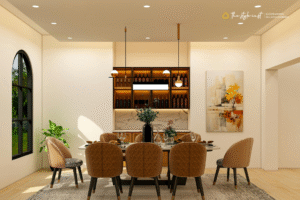
The emotional tone of the house is very much set by the living areas, and they often turn out to be the places where buyers have their strongest first impressions. When staging a house, these areas have to be nice and warm, soft, and versatile to accommodate both daily living and entertaining.
Living rooms, lounges, and open-plan living zones have to be elegant and at the same time very functional. Overstyling can become very uncomfortable and even feel like a mess, while understyling can turn the spaces into very cold and unfriendly places or give them an unfinished look. The goal of staging a house for living areas is to create a warm, aspirational environment that appeals to a broad range of buyers.
Living areas styling focus during the staging of the house:
- Use a neutral colour palette to maximise buyer appeal
- Add soft furnishings such as cushions and throws for warmth
- Keep décor minimal but intentional to avoid visual clutter
- Arrange furniture to encourage conversation and flow
- Highlight natural light and architectural features
Well-staged living areas can make buyers think about themselves as already relaxing, hosting, and spending time in the space- an emotional trigger which is very important in the process of making your home ready for selling.
7.2 Kitchen
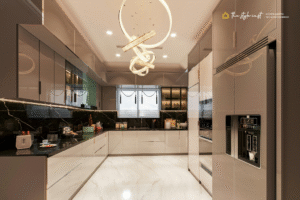
The kitchen is probably the most important room in a house and the most significant factor for buyers. It is essential to make the kitchen area clean, functional, and spacious when staging a house, no matter how small the kitchen is.
Making your house ready for selling in the kitchen is not so much about decoration but about improving visibility. The buyers are viewing the availability of countertop space, the total capacity for storage, and the flow of the work done in the kitchen. It is thus that even a modern kitchen can become impractical through cluttered surfaces or by overwhelming styling.
- The process of preparing a home for sale, specifically in the kitchen, requires you to:
- Clear the benches so that the workspace is accessible and visible
- Include soft décor items like a bowl of fruit or a small plant
- Present the storage space by arranging cabinets and drawers
- Make certain that the appliances are spotless, functioning well
- Use neutral colors and simple finishes
Good kitchen staging substantiates the primary intention of the entire staging procedure, that is, to make it functional, clean, and usable in daily life. These factors have a great influence on the buyers’ decisions.
7.3 Bedrooms
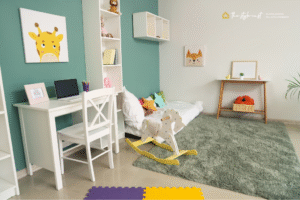
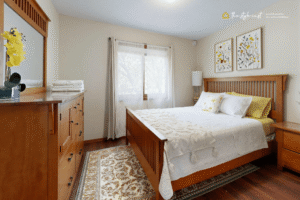
The bedrooms should be places where one can be calm, rest, and feel welcomed. When staging a home, the decorators in these areas do so with the intent of attracting people who love to relax and enjoy rather than those who want to live in an area that expresses their personality. The moment the buyers step into a bedroom, they should feel relaxedOvercrowded bedrooms can give the feeling of being small,e, which is more so with personal décor, or making the room less attractive to buyers. When staging a house, the bedrooms are done with the thoughts of simplicity, balance, and a hotel-like experience that feels good to everyone.
Here are the tips for the seller regarding staging bedrooms:
- The hotel-style bedding made of neutral colors should be used
- Remove the extra furniture to make the place look bigger
- Let the décor be minimal, and the ces be clear
- Make the wardrobes look big and neat
- Use soft, layered lighting to create a warm atmosphere
Staged bedrooms with restraint and care allow the buyers to see themselves having restful nights and peaceful routines, which,h, in turn, is the emotional bond that is created when the home is being prepared for sale.
7.4 Bathrooms
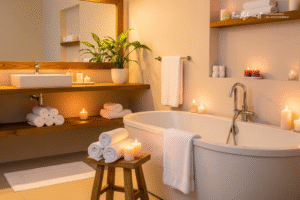
The buyer’s perception is powerfully influenced by bathrooms. To support the total house staging impact, even small bathrooms can be made to feel luxurious through prop styling, the same time as selling bathrooms, hygiene, relaxation, and quality should be communicated.
Remember that there will be no second chance to make a first impression at the Sale of your property. Dispensing sometimes on slight awareness can lead to the whole house losing appeal, thus cutting down on what is perceived as the property’s value.
Here is a pre-listing checklist for bathroom staging:
- Use new or freshly laundered towels
- Ensure all surfaces are spotless and sparkling
- Remove personal items from showers and vanities
- Add subtle, neutral touches for a spa-like feel
A perfectly staged bathroom sends signals to home buyers that the house has been properly maintained. This way, the emotional connection to the properties created and the effect of staging a house is amplified throughout the entire estate.
Final Thoughts
One of the most effective methods to stage a house is to make it look more appealing to buyers and even increase its value in the eyes of the buyers when preparing your home for sale. Sellers can emphasize their property’s best features, lessen doubt, and make very strong emotional attachments by adhering to a well-organized pre-listing checklist and adopting a buyer-oriented approach.
Staging a house involves everything from clearing out and fixing to placing furniture and decorating one room after another. It makes sure that every room has a purpose, is warm, and is ready for the market. When it is performed well, it allows roofs to be seen in a very special way through the internet, to attract serious buyers, and finally to do it confidently.
Staging does not refer to the decoration of a house; rather, it is the process of showing the home in its best condition.