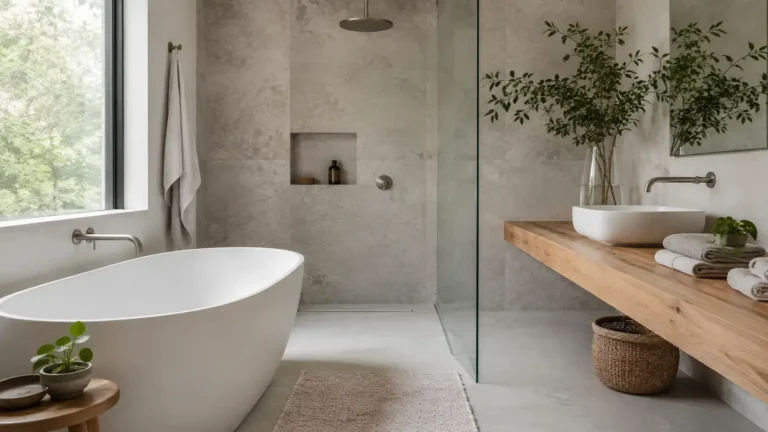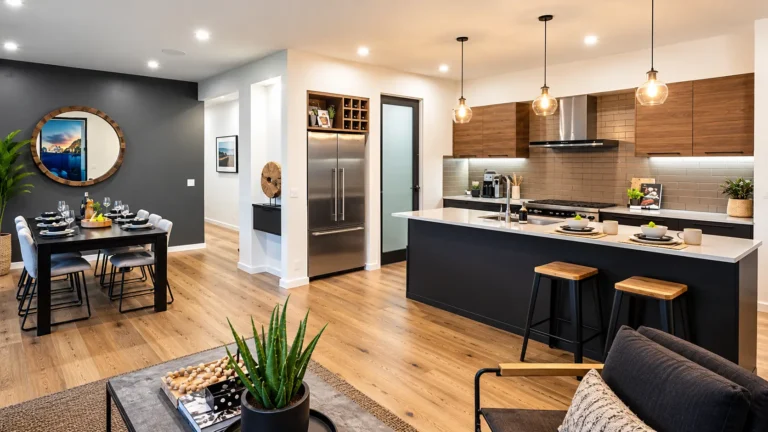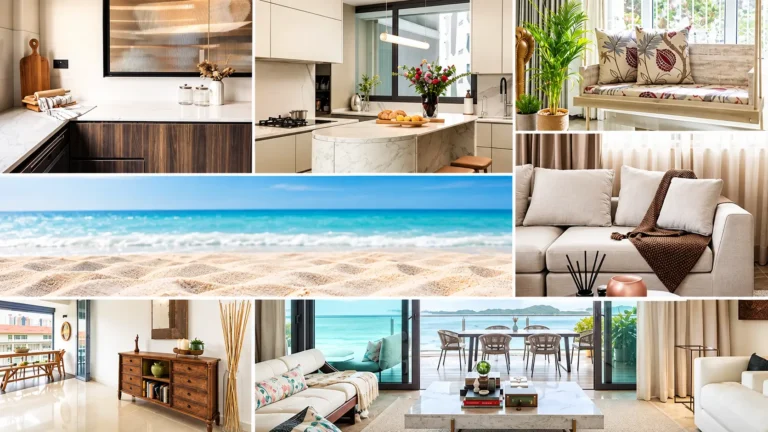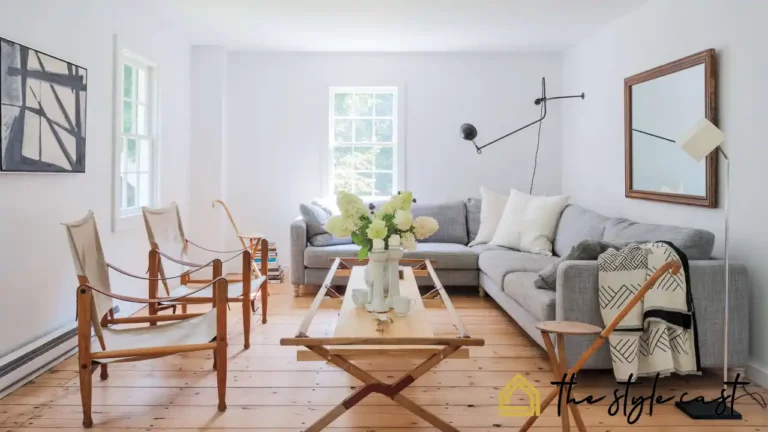
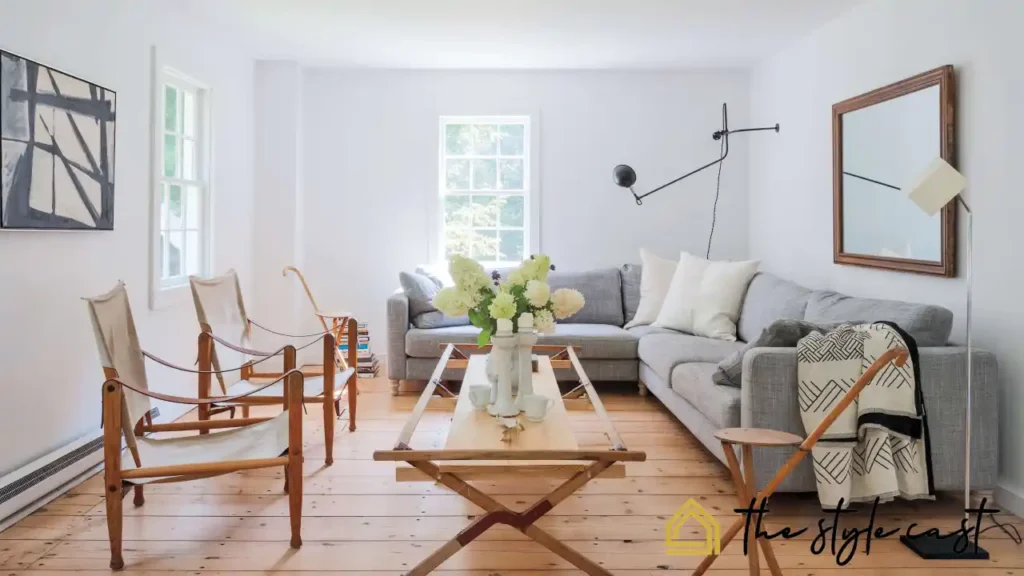
To make a room look bigger without renovating, work on sightlines and contrast rather than furniture. Paint walls, ceiling and trim the same light colour, keep the floor surface continuous between rooms, clear the sightline from every doorway, hang curtains close to the ceiling, and use one large mirror to reflect a window. Reducing the number of visual breaks does more than moving furniture around.
Perceived Size Is Not the Same as Actual Size
Two rooms with identical dimensions can feel a metre apart in size. That gap is not imagination. It comes from how the eye estimates space, and the eye uses a handful of cues it can be reliably fooled by.
It reads contrast breaks. Every line where one colour stops and another starts registers as an edge, and edges make a room feel segmented.
It reads sightline depth. The further the eye can travel before hitting something, the larger the space feels.
It reads vertical proportion. Anything that draws the eye upward extends the perceived ceiling.
It reads floor coverage. Visible continuous floor equals space. Interrupted floor equals less space.
Every technique below manipulates one of those four cues. That is why they work in a Melbourne period terrace and a new build in Tarneit equally, regardless of the actual floor plan.
Colour and Contrast
1. Paint the trim the same colour as the walls
Skirting boards, architraves and doors painted in the wall colour remove the strongest horizontal and vertical lines in the room. This is probably the highest-impact single change on this list and most people never consider it. Contrasting white trim against coloured walls draws a box around the room, and boxes feel finite.
2. Carry the wall colour onto the ceiling
Not pure white above a coloured wall. Use the wall colour at around 50 percent strength on the ceiling, or the same colour throughout. The corner where wall meets ceiling stops registering as a hard stop and the room feels taller.
3. Use one paint colour through connected rooms
Where a hallway opens to a living room and then a dining area, one colour across all three makes them read as a single volume. Changing colour at each doorway chops the home into small compartments.
4. Go light, but warm
Cool white and grey reflect light but can read as flat and cold, especially in south-facing Melbourne rooms through winter. Warm whites, oatmeal and soft sand reflect nearly as much light and keep the room feeling inhabited.
5. Avoid feature walls
A dark or patterned accent wall pulls itself forward visually, which shortens the room. It also narrows your buyer pool if you are selling. More on that in home presentation mistakes to avoid.
Floor and Sightlines
6. Keep flooring continuous
Where the same flooring runs through multiple rooms, the whole area reads as one space. Different flooring at every threshold creates a break at each doorway. If replacing floors is not on the table, matching the tone of rugs across adjoining rooms achieves some of the same effect.
7. Clear the sightline from every doorway
Stand in each doorway and look straight ahead. Whatever sits in that line is the thing limiting the perceived depth of the room. Move it. The best sightline ends at a window, a piece of artwork or an open doorway into another room.
8. Show as much floor as possible
Furniture on legs, wall-mounted TVs and floating shelves all leave floor visible. The eye estimates room size largely from uninterrupted floor area, so anything sitting flat on the ground reduces the count.
9. Use one large rug instead of several small ones
Multiple small rugs cut the floor into pieces. One generous rug reads as a single surface. This applies across the home, not just in the lounge.
10. Empty the corners
Corners packed with objects make walls feel closer. One plant or one floor lamp in a corner is fine. A stack of anything is not.
Height and Light
11. Hang curtains near the ceiling and wide of the frame
Mount the rod 15 to 20 centimetres below the ceiling and extend it 15 to 20 centimetres past the window on each side. The window appears taller and larger, and the curtains stack against wall rather than glass so no light is lost.
12. Choose floor-length curtains that just kiss the floor
Curtains stopping at the sill cut the wall in half horizontally. Full-length panels draw a continuous vertical line from ceiling to floor.
13. Add one large mirror positioned to reflect a window
Not several small mirrors, and not a mirror reflecting a blank wall or a cluttered room. One well-placed mirror effectively doubles the apparent depth in that direction and adds a second source of light.
14. Light from three heights
A ceiling light alone flattens a room and pushes the walls in. Adding a floor lamp and a table lamp creates pools of light at different depths, and depth reads as space. Keep every globe at the same warm temperature, 2700K to 3000K, so the room does not look patchy.
15. Draw the eye upward
Tall narrow shelving, a vertical artwork, a pendant hung slightly higher than you think, or a plant with height. Anything that makes the eye travel up extends the perceived ceiling. This is particularly useful in rooms with standard 2.4 metre ceilings.
Space Illusion Tips by Room
| Room | Highest impact change |
|---|---|
| Living room | One oversized rug and floated seating |
| Bedroom | White bedding and matched bedside symmetry |
| Kitchen | Benchtops cleared to two or three items |
| Bathroom | Large mirror and everything off the vanity |
| Hallway | One tall mirror and a floor runner |
| Dining | Pendant centred and chairs matched |
Room-specific detail lives in our living room ideas and bedroom ideas guides, with home decor ideas covering the whole house.
What Makes a Room Look Smaller
Worth knowing in reverse, because most people are undoing their own work somewhere.
- Dark ceilings in rooms under 2.7 metres high
- Small rugs floating in the centre of a floor
- Heavy curtains hung at the top of the window frame only
- Furniture with skirted bases that block the floor
- Open shelving packed full, which reads as visual noise
- Multiple small artworks scattered across one wall
- Contrasting white trim against strong wall colour
- Bulky pelmets and blinds that eat into the glass
- Anything stored on the floor that is not furniture
That last one keeps appearing across this series because it is the single most common problem in Australian homes and the only one that costs nothing to fix.
Making Rooms Look Bigger in Listing Photos
Perceived size in photography follows slightly different rules, and this matters because most buyers form their first impression on a screen.
Shoot with lamps on and blinds fully open. Layered light gives the room depth on camera.
Remove one more item than feels necessary. Cameras compress space and make clutter look worse than it does in person.
Keep the floor visible in the frame. Photographers often shoot from a slightly lower angle to increase visible floor and ceiling.
Check the sightlines through doorways before the shoot, since the photographer will use them to create depth.
Style for the wide shot, not the detail shot. Most listing images are wide. Small vignettes rarely make the gallery.
If the property is empty, this is much harder, because cameras exaggerate the emptiness and buyers lose all sense of scale. Vacant home staging exists specifically to solve that problem.
Frequently Asked Questions
What colour makes a room look bigger?
Warm white or a light neutral applied to walls, ceiling and trim together. The specific colour matters less than the consistency, since reducing the contrast between surfaces removes the visual edges that make a room feel enclosed.
Do mirrors really make a room look bigger?
Yes, when there is one of them and it reflects something worth reflecting, usually a window or an open sightline. A mirror facing a blank wall or a cluttered space adds nothing and can make the room feel busier.
Should the ceiling be white to make a room look taller?
Not necessarily. A ceiling painted in the wall colour, or a lighter version of it, often reads as taller than a bright white ceiling above a coloured wall, because it removes the hard line where the two meet.
How can I make a room look bigger without buying anything?
Clear the floor, empty the corners, cut items on surfaces by half, move whatever blocks the sightline from each doorway, and pull furniture slightly off the walls. Those five changes cost nothing and take an afternoon.
Does styling actually change how buyers judge room size?
Buyers consistently estimate styled rooms as larger than the same rooms unfurnished or over-furnished, because furniture at the right scale gives them a reference point. Our piece on the psychology behind why staged homes sell faster covers the research side of this.
Key Takeaways
- Perceived size is driven by contrast breaks, sightlines, height cues and visible floor
- Painting trim and ceiling to match the walls is the highest-return change most people skip
- One large rug, one large mirror, one large artwork beat several small ones every time
- Curtains high and wide, lighting from three heights, corners kept empty
- Clearing the floor costs nothing and does more than most purchases
For a whole-home version of this thinking, see top 10 tricks to make small homes feel spacious, and for compact lounges specifically, small living room ideas has the measurements. If you want the whole property handled before photography, we offer styling and interior design and staging solutions across Melbourne, including home styling in Glen Waverley and the suburbs on our locations page. Get in touch for a walkthrough.